



A self-driving car must read a changing road, predict what people will do, and act safely when its sensors disagree. That work happens in seconds, often with incomplete information and no human ready to take over.
- Road scenes change faster than maps
- Rain, glare, and blocked sensors weaken perception
- Safe travel depends on prediction, not detection alone
Seeing the road is only the first job
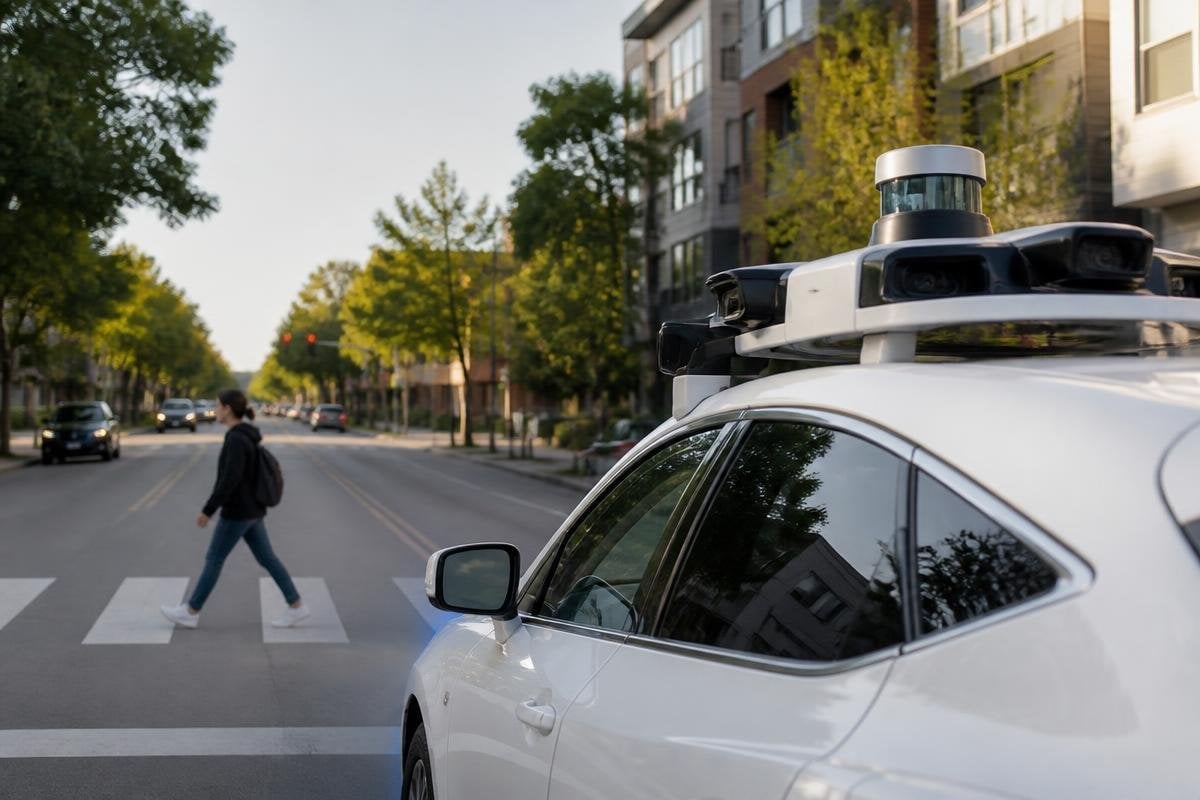
An autonomous car uses cameras, radar, LiDAR, GPS, and other sensors to build a view of its surroundings. Each tool sees a different part of the scene, so the car must combine those inputs before it chooses a path.
Cameras can read lane markings and traffic lights, while radar can measure the distance and speed of nearby objects. LiDAR can map the shape of objects around the car. None of these sensors gives a perfect view in every setting, and a blocked camera or dirty LiDAR window can remove useful information at the worst moment.
The software must also decide what an object is. A plastic bag, a fallen branch, and a person may appear as small shapes at a distance. The car needs enough confidence to react, yet it can’t treat every uncertain object as a full emergency without making normal travel unsafe.
Roads do not stay still
Maps help an autonomous car know where lanes, signs, and junctions should be. Road work can move a lane overnight. A delivery truck can hide a sign. A temporary barrier can guide traffic through a path the map never described.
This creates a constant gap between the stored map and the road in front of the car. The car must use its sensors to check the map, then plan around anything that has changed. A route that works on a quiet morning may need a different decision during a crowded event or a sudden lane closure.
Weather adds another layer. Rain can reflect light, snow can cover lane markings, and low sun can make a camera lose detail. The system needs a safe response when its view gets worse, such as slowing down, stopping, or handing control back to a person where that option exists.
A road test needs more than a clean sensor view. Check the weather, road layout, sensor limits, and human backup in autonomous driving reports from Robot24.com. Those facts set up the harder task: predicting what another road user will do.
Prediction is harder than detection
Finding a cyclist is one task. Predicting that cyclist’s next move is another. The person may continue straight, turn across traffic, stop near a parked car, or change direction after seeing a vehicle approach.
People at the wheel use eye contact, road position, speed, and local habits to judge these moments. An autonomous system must turn similar clues into a planned action. It also needs to account for several people and vehicles at once, each with a different possible path.
That uncertainty affects the car’s travel style. A system that waits too long can block traffic or miss a safe gap. A system that moves too soon can create danger. The software needs a plan that leaves enough space for mistakes by other road users.
Testing the rare cases
Most road trips contain long stretches of ordinary travel. The hard tests come from unusual combinations: a person near a stopped vehicle, a cyclist beside a turning car, poor visibility, unclear road markings, and another vehicle breaking the rules at the same time.
A test fleet can collect sensor data from these events, then use it to check later software versions. Simulation can add more cases without sending a car onto public roads, but a simulation still depends on the situations its designers thought to include.
This is why a smooth demo proves only that the system handled that route, weather, traffic pattern, and set of people. It doesn’t settle how the car behaves across every road it may meet.
A practical check before trusting a claim
Use these questions when a company presents an autonomous-system result:
- Name the task: Was the car moving, parking, following a route, or handling a specific road feature?
- Check the setting: Did the test include public roads, traffic, weather, and night conditions?
- Find the backup: Was a safety driver present, and how often did they take control?
- Read the limits: Does the system restrict speed, roads, weather, or mapped areas?
- Look for repeat tests: Was the result shown once, or across many routes and conditions?
I’d treat any claim without these details as a demo, not proof of a finished system for road travel.
The next useful measure is not a smoother video. It is a clear record of where the car works, where it stops, and how often a person must intervene.